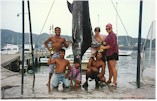
| Thousands of people come to Manzanillo each year to fish,
and I wonder how many guys I've seen with the following T-shirt slogans: "The worst day fishing is better than the best day working." "My wife told me I would have to choose between her or fishing. Sure gonna miss her." "I live to fish!" Being a scuba diver, I would rather photograph fish than catch them, but I'll have to admit that deep sea fishing is very alluring. Having grown up in the south, where catching a 3-pound bass can bring admiring looks from other fishermen, the thought of hooking a 125-lb. sailfish and reeling him in is hard for me to imagine.
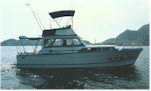
At about 6:30 a.m. I arrived at the La Perlita dock in downtown Manzanillo. It's not even light by that time, and a little chilly, but I could already hear the muted sounds of the fishermen cleaning their boats, and bringing on the bait, rods, coolers, sodas, beers, ice, and other assorted fishing gear. It takes a lot to get ready to catch the BIG ONE, I guess! I watch as other tourists arrive by cab for their designated charter boats, some with obvious hangovers from the night before (They'll be feeding the fish out there--without bait!), others already on their first beer of the day. Long live tourist season! Sam, the boat owner, checked with me and asked if I got seasick. Fortunately, I never do, but he had a product known as a "sea band," which is wrapped around the wrist on an acupressure point that eliminates the problem in most people. Since deep sea fishing boats usually head out to blue water in open ocean, up to 50 miles away from the harbor, it's a good idea to prepare yourself by taking an anti-nausea medication. The roll and swell of the ocean can get to you if you're not used to it, especially after visiting the Colima Bay Cafe the night before. Finally, they were ready for me, and as I was helped aboard by Hugo, the gorgeous green-eyed Mexican boat captain...(well enough about that), I noticed that the deck, chairs and cabin were sparking clean and didn't smell a bit like dead fish. This was good. At the back of the cruiser were two chairs, bolted to the floor, each having some sort of a swiveling holder thingy between your legs when you sat down. Hmm, too small for a beer, I thought, so I asked Sam what they were for. He patiently explained that they were holders which are used to support the base of the fishing rod, and would assist you in bringing in your fish. The chair itself had a name; it was called a "fighting chair," which is designed to give the angler leverage to resist the pull of an animal which can weigh much more than he does. Hugo casts off, and begins to slowly motor out of the harbor. Sam explains that in Manzanillo, which is the deepest natural harbor in Mexico, it is not unusual to catch a sailfish only a few minutes out of the port. As soon as we cleared the jetty, Hugo set the course and left the boat on automatic pilot, hopped down from the bridge and proceeded to put out nine fishing lines. This is a complicated procedure, since at 7 in the morning, no one is sure what the sailfish are really wanting to eat that day. Having an experienced captain who really enjoys fishing is important at this stage.
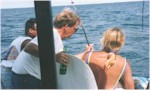
Suddenly and unexpectedly (because we were only 5 minutes out) the line on one of the poles whirred, and Sam shouted excitedly, "We've got a hit!" I scrambled down from the bridge, as did Hugo, who started reeling in all the other lines that he'd so carefully put out only moments before. Sam had me sit in the fighting chair and handed me the rod. He showed me how to pull the rod up, then drop it down and reel, pull it up, drop it down and reel, over and over. I was holding the rod, and thought to myself, "Who needs that rod holder?" when Sam announced that the fish was "only a tuna." I wondered, "That's good, isn't it? After all, we have a tuna processing plant in town, and so somebody must like tuna." Anyway, the "little" 8-pound guy put up quite a fight, and I must say, after fishing all my life for perch, trout, bass, and crappie (all a pound or under), reeling in 8 pounds of thrashing, fighting fish is a lot of fun. Hugo smiled as he removed the tuna from the hook and said, "This will make good ceviche!" (Ceviche is a Mexican appetizer made with chopped raw fish, onions, tomatoes and cilantro, marinated in lime juice and served on crisp tostadas). I found out later that was to be our lunch. We put the lines out once more, and almost immediately caught more tuna. The process of Hugo and Sam reeling in the empty lines (so the thrashing fish doesn't swim over and under them, getting them tangled), went on several times, as we continued to catch tuna. We were in a school. Finally Sam said, "Let's keep the lines in until we get out of this school; we've caught enough tuna, and I want to get to where the sails and marlin are." That was okay with me; my arms were tired and we'd spent 2 hours reeling in fish and we weren't even out of the port yet! Things quieted down as we trolled out to blue water, that day about 7 miles due west. The sea was calm and the morning sun was out, and I enjoyed a coke (breakfast) on the bridge. An hour went by and nothing much happened, other than the fact that Sam and I decided to have our first beer of the day. Hugo doesn't drink while on the job, so we saluted him and enjoyed the ice cold brew. Hugo was up and down from the bridge, reeling in one line, then another, trying different lures and bait. He was constantly on the radio with other charter boat captains, checking to see if they'd caught anything, and if so, where was their location? Nowadays, many fishing boats are equipped with radar and GPS (global positioning satellite) receivers, but Hugo was born on the ocean and he could find ANYONE AND ANYTHING by dead reckoning. He was watching the feeding birds and the jumping fish (which means that bigger fish are probably chasing them below). The type of fish jumping determines what the fish below might be, just as he knows that certain birds feed on certain types of fish, which in turn are the food of certain other types of larger fish. Predator and prey. Few anglers who charter big game boats and captains could possibly catch fish by themselves.
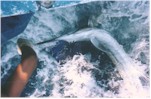
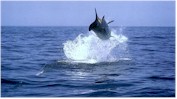
Sam sits me down in the The fish jumped again, shaking its head from side to side, trying to rid itself of the hook. This time he was only about 60 yards from the boat. Only about 10 minutes had passed, but my arms were getting tired, and I was relieved that the fish was so close to the boat. I imagined the battle was almost over, but suddenly, Sam starts to let out more line from my reel, until the spool was almost empty.
A word about catch and release: Sam is the only charter fishing boat owner in Manzanillo that willingly supports catch and release, which is why I choose him. Manzanillo is the "Sailfish Capital of the World," but won't be forever, if we don't do something to change our wasteful and ecologically ignorant attitudes toward sportfishing. We enjoy fishing because encounters with great pelagics, such as sailfish and marlin are exciting and challenging. The sea is an enigma; we'll probably never completely understand it. Perhaps part of the seduction of big game fishing is involving ourselves in the ocean's mysteries by encounters with animals so large that, other than man, they have few natural predators. A contest between two great species--man and fish--doesn't have to end in the death of the "loser." A true champion prides himself on showing compassion and mercy to the defeated. In this instance, by promoting catch and release, and refusing to go out with boat captains who will not honor your request, you can help protect our finite ocean resources. I've learned that some captains promise to release your fish, but don't do so once you're on their boat. Others say they donate the fish to orphanages or hospitals. They don't. The fish are sold at the market. There's a hefty profit in these big fish, and the boat captain receives 2 benefits; he makes money from you for the trip, then money off the fish you catch.
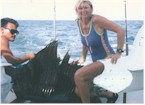
It is easy to understand why sailfishing is such a popular sport. There's action, excitement, challenge and adventure rolled up into one 5-hour package for a very reasonable price. (Deep sea fishing costs much less in Manzanillo than in Baja California or Florida.) When you take up the challenge of fishing for the BIG ONE in Manzanillo, tell your story to the webmaster@gomanzanillo.com. And remember, you don't always get lucky like I did and catch a beauty the first time out. (If you caught fish every time you tried, we'd call it catching instead of fishing!) For more information on deep sea fishing, and other popular Manzanillo activities, order the 150-page tourist guidebook, "Manzanillo and the state of Colima, Facts, Tips and Day Trips." Sam and Marilyn Short at Ocean Pacific Adventures can take your reservations or answer your questions by e-mail: fish@gomanzanillo 2012 NOTE: This story was written about 12 years ago. Sam Short passed away 2011 after a long fight with cancer. I didn't want to change this article as a tribute to a fine and funny man who will be in my heart always. If there are BIG ONES up there, I know what Sam is doing! |