Living
coral reefs attract millions of snorkelers each year. But they can also be a
serious threat to the fragile ecosystem. Snorkelers have at least one negative
contact with the corals for every 30 minutes in the water. Help us protect our
reefs by avoiding the following:
|
YOU
CAN MAKE A DIFFERENCE!
The
problems are critical, but not hopeless.
Some people believe in a cause so strongly they
donate car toys to children's
charities or even actual cars, but change really starts with education and doing
something as simple as buying our guidebook!
Did you know that one
dollar from the
sale of the
Manzanillo guidebook and one dollar
from every snorkel trip you take with SCUBA
SHACK
goes to clean up our ocean and beaches in Manzanillo? Every snorkeler,
whether novice or expert, is a vital link in nature's complex eco-system. We
hold the future of the earth's oceans in our hands. Educate your children and
set an example.
Refine
your technique; become a better snorkeler with these tips:
 The
number one rule when you're snorkeling is to do your part to protect the
underwater environment. To do so, you need to become a better snorkeler and
refine your techniques so you'll feel like a dolphin, slicing effortlessly
through the water, your mask, snorkel and fins becoming part of your body.
The
number one rule when you're snorkeling is to do your part to protect the
underwater environment. To do so, you need to become a better snorkeler and
refine your techniques so you'll feel like a dolphin, slicing effortlessly
through the water, your mask, snorkel and fins becoming part of your body.
If
instead, you're starting out like an uncoordinated turtle, using your hands,
treading water, breathing hard, or standing on the coral, here are a few hints
to make you more comfortable.
If
you need to remove your mask while in the water, relax, take a partial
breath and hold it so that you will know if you are naturally buoyant (most
people are). Breathe shallow breaths keeping your lungs half full with air
(you float higher that way). Remove your mask, make the adjustment, and put
it back on by placing the mask against your face, then pulling the strap up
and over your head. Under no circumstances should you rest your mask on your
forehead. It is a sign to all trained guides that you are stressed and/or in
trouble. You can also easily loose your mask if you are hit by a wave. The
proper place to put your
mask when it is off your face is around your neck.
place to put your
mask when it is off your face is around your neck.
If you have a mustache, bring petroleum jelly along to help seal your mask. Spread liberally on your mustache hairs, where they meet the skirt of the mask. (After using petroleum jelly on your mask, wash your mask well with soap to remove it. The petroleum-based product is not compatible with the silicone mask skirt.)
Don't
try to enter the water wearing fins. Walk in with your fins in your hand
(mask and snorkel in place), turn around and face the beach so your back is
blocking the wave action. Then put your fins on. (You should be at least
waist deep in the water, relaxed and floating, out of the breaking waves.)
When
snorkeling from the beach, start
off in shallow water (in a sandy area, if possible) and wait until you are
comfortable in a shallow depth before venturing into deeper water. From a
boat, enter the water with your mask, snorkel and fins in place.
It's
best to leave everything in the ocean, but if you simply must take a shell
for a souvenir, make sure it's devoid of a hermit crab or snail. (Baby
octopi also enjoy inhabiting small shells.)
 The
wave action is called surge (the motion of the ocean). Relax and enjoy it;
let it rock you back and forth. It is not a current.
The
wave action is called surge (the motion of the ocean). Relax and enjoy it;
let it rock you back and forth. It is not a current.
Look close up as well as far away. Sea anemones, crabs, mollusks and other tiny creatures hide in the coral heads. Larger fish, such as grouper and parrotfish are shy and keep their distance.
If you get cold, do some free diving or swim to warm up. Ask for a wetsuit if you chill easily. If your guide wears a wet suit, it's smart to wear one, too.
If
you begin to tire, float for a while. Snorkeling is easy and need not
require a lot of work. Most of snorkeling is floating and watching.
Do not stand on the rocks or coral. A coral head is made up of millions of living animals, and rocks are encrusted with living organisms. Respect the sea and let it be there for your children. Tell others that are unknowingly killing our sea creatures. Take a stand! (But not on the coral.)
This
article is reprinted from Susan Dearing's Manzanillo guidebook.
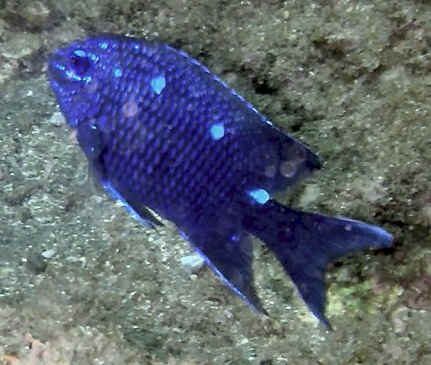 1.
Simply relax and move slowly. Marine life is less
threatened by a relaxed snorkeler. Swimming slowly is not only
more comfortable for you, but also is less likely to intimidate
the wildlife you have come to observe. Many creatures are
extremely sensitive to vibrations in the water, and in fact depend
on this sense for their survival. Quick motions of snorkelers are
easily perceived as potential threats by many fish and
invertebrates.
1.
Simply relax and move slowly. Marine life is less
threatened by a relaxed snorkeler. Swimming slowly is not only
more comfortable for you, but also is less likely to intimidate
the wildlife you have come to observe. Many creatures are
extremely sensitive to vibrations in the water, and in fact depend
on this sense for their survival. Quick motions of snorkelers are
easily perceived as potential threats by many fish and
invertebrates.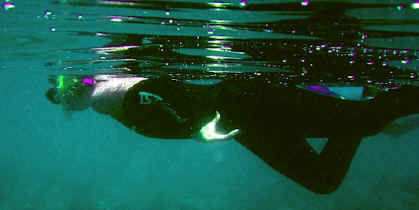 4.
Leave nothing but bubbles. Although you don’t see as many
signs as along a typical highway, littering under water is just as
inappropriate as it is on land. We always carry trash bags during
our outings, both from shore and from boats. Please use these
containers rather than disposing refuse in the water. Pay special
attention to plastic bags. They blow away easily and once in the
water they closely resemble jellyfish, the main diet of many
turtles. And if you see trash, pick it up. We do.
4.
Leave nothing but bubbles. Although you don’t see as many
signs as along a typical highway, littering under water is just as
inappropriate as it is on land. We always carry trash bags during
our outings, both from shore and from boats. Please use these
containers rather than disposing refuse in the water. Pay special
attention to plastic bags. They blow away easily and once in the
water they closely resemble jellyfish, the main diet of many
turtles. And if you see trash, pick it up. We do.