
Colima's active volcano
 VOLCANO
TOURS (see below)
VOLCANO
TOURS (see below)
Click on pictures below to enlarge. Pictures taken between 1990 and 2010.
 |
Centuries-old legends say that more than 3,000
years ago the God of fire looked down from the volcano, Nevado
de Colima, to advise and give solace to the inhabitants of this
region.
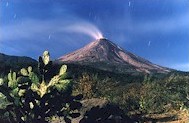
His hot-tempered younger brother, who resided in the Volcan de Colima, instilled fear in the hearts of his worshippers and would severely punish those who didn't please him. Colima's volcano has been active for five million years. In the late Pleistocene era, a huge landslide occurred at the mountain, with debris traveling some 120 km, reaching the Pacific Ocean. This is the reason Manzanillo's sand beaches are comprised of both black and golden sand. |
 |
 |
 |
|
 |
Driving north from
Manzanillo, tourists will always remember their first view of the majestic mountains of
Colima. The inactive, snow-capped Nevado de Colima,
towering above 14,200 feet and its active smoke-and lava-spewing partner, Volcan de Colima,
at more than 13,488 feet overlook a lush, forested valley and tranquil lake.
Lake Maria is formed by another extinct volcanic crater, and is said to be
2,000 ft. deep. The Colima volcano is the most active volcano in Mexico, having erupted violently several times over the last 450 years. About 4,000 years ago it produced a cataclysmic avalanche much larger than that of Mount St. Helen's. Written accounts of the volcano's eruptions date from shortly after the Spanish conquest of Mexico. |
 |
 |
 |
|
 |
One of the earliest recordings of an eruption was in 1576,
followed by another in 1590. From 1611-13 there was a period of violent pyroclastic
explosions (reminiscent of Pierce Brosnan's "Dante's
Peak") with strong earthquakes. There was peace at last for 138 years, but in 1743 a strong earthquake was felt in Ciudad Guzman in the neighboring state of Jalisco. In 1749, another eruption occurred; in 1770 an enormous outpouring of ash; in 1795 an eruption of glowing cinders, and finally in 1806, an earthquake that killed an estimated 2,000 people in Ciudad Guzman. Sporadic eruptions continued through 1818; then, for 51 years, the volcano showed no eruptive activity. |
 |
 |
 |
|
 |
In 1869 an unusual occurrence happened. A small parasitic cone,
now called El Volcancito, formed
one-kilometer northeast of the main crater. Continued weak activity interspersed with some
fairly potent explosions continued through 1913, when a major eruption occurred,
characterized by heavy ash flows and the formation of a summit crater measuring more than
900 feet in depth. Once again, the pressure was relieved, and the volcano stood essentially dormant for 48 years. In 1941, the city of Colima was on the receiving end of a strong earthquake, resulting in massive destruction. Much of the city's historical buildings had to be rebuilt after this quake. Minor eruptions continued 1961 through 1981, with a new dome formed in the eastern part of the crater. In 1985, a magnitude 8 earthquake opened new cracks, followed by an ash eruption in 1986, and an explosion and avalanche from the dome. New vents opened, releasing some of the built-up pressure, but in 1991 and 1994 it erupted again. |
 |
 |
 |
|
 |
 |
|
The current status on the volcano is that it is very active. In November of 1998, 250 people were evacuated from villages surrounding Colima due to warnings that an eruption was likely to occur. Thousands of small tremors have been recorded at the volcano. A plume was seen above the volcano on November 18. Planes surveying the volcano recorded temperatures of 1,470 degrees Fahrenheit inside the crater. Lava was also reported to have risen high within the crater.
On February 14, further explosions and small earthquakes forced the evacuation of about 350 more individuals from the northern flanks of the volcano. Small pyroclastic flows have accompanied many of these explosions. Activity at the volcano increased until on February 22, four eruptive explosions occurred at the summit. There was also an increase in seismic activity.
Since June 1, the volcano has been experiencing explosive activity. Six explosions occurred on June 2. On June 5 there were 4 explosive events. On the 7th, 9 explosions occurred, and still another on the 8th. On the 16th, and then again on the 18th, more explosions occurred.
Come and join Manzanillo Adventure Tours on a marvelous journey through endless palm forests, gorgeous valleys and deep canyons. There you can enjoy the Nevado National Park, which is more than 13,000 feet high and has a spectacular view of its neighboring peak, "El Volcan de Fuego." We offer you these choices:
VOLCANO VALLEY HORSEBACK RIDING TOUR (Half day, approximately 5½ hours) If you like horseback riding and nature, this is the tour for you! Ride along different plantations, such as sugar cane, guava, coffee, corn; enjoy birdwatching, lunch at a traditional Mexican restaurant, served on corn tortillas made by hand just for you! Visit Suchitlan's indigenous mask maker/shaman, and on your way back, get ready for some volcano sightseeing. The ride is about 3 hours. $85 USD SNOW VOLCANO TOUR (full day, approximately 10 hours) Ever been to over $13,000 ft. in Mexico? We reach 11,500 ft. by car, and then trek the rest of the way. Full explanation of history and facts--and hazards. You'll get as close as 3½ miles from the crater. (You'll standing on the dormant volcano, called the Volcan de Nieve, or Snow Volcano.) Children 8 years and up. $125 USD TREKKING VOLCANO TOUR SIGHTSEEING (Half day, approximately 5½ hours) Hike along coffee, banana, mango, sugar cane, tamarind and corn plantations, cross over 2 hanging bridges, and enjoy birding as well as a view of the volcanoes. $50 USD Tour prices include transportation to and from Manzanillo-Colima. Once arriving in Colima you will be met by your guide for the day. Lunch, where mentioned is included, as are all entrance fees. Reservations on line are done through Pay Pal, which is safe and secure for both sides. At the Manzanillo Adventure Tours office, VISA, MasterCard, Traveler's Checks, U.S. dollars, and pesos are accepted. If paying in pesos, the current local exchange rate will be used. Added to the tour time is the 2 hour transportation time to and from Manzanillo. If you are staying in Colima, your guide will meet you at your hotel. Looking for a great B & B in Comala? Try Casa Alvarada. Let them know Susan at Manzanillo Adventure Tours recommended you.
For more information on these
and other tours,
e-mail. For more information on other tourist
attractions in the state of Colima, check out the 150-page tourist
guidebook, entitled, "Manzanillo and the State of Colima, Facts, Tips and
Day Trips. |


 Observe Mexico's most active
volcano!
Observe Mexico's most active
volcano!