 |
Foster home children
tour U.S. Navy's
newest combat ship
Helping Manzanillo children
through Project Handclasp
There is no denying
that the U.S.S. Independence is an amazing warship. What's more
amazing is its incredible crew, and how the young men and women of the
U.S. Navy generously donated their time to give some of Manzanillo's
disadvantaged children an experience of a lifetime.
When the U.S.S. Independence arrived in Manzanillo in late April
2012, first on the agenda was a visit to the local orphanage/foster home
named Liborio Espinosa Casa Hogar. This 40-bed facility currently
houses 15 children ranging in age from 5 to 18. There have been times in
years past where the facility has had up to 38 children.
The orphanage was
founded 15 years ago by a priest, Father Jose Carlos, according to
Director Claudia Ramos. It provides food, housing and education for
children with no parents or parents who cannot provide for their
children due to abuse by a family member, illness of a mother in a
single parent household, alcohol or drug problems, or other situations. |
Please click on photos to enlarge
|
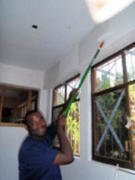
Getting the job done
with a smile |
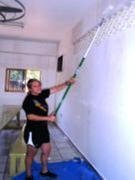
Women can paint
too! |
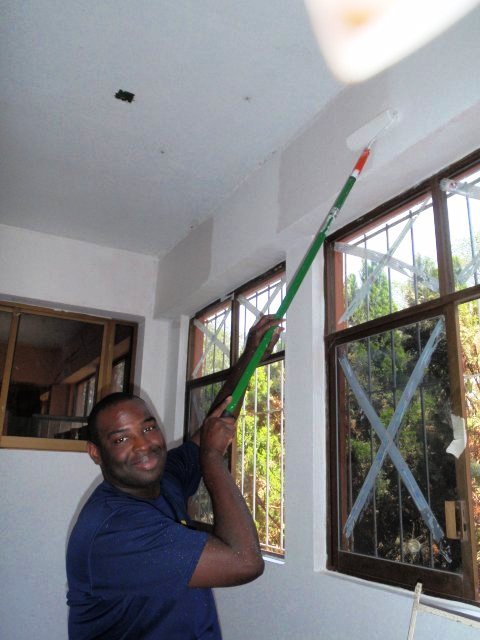
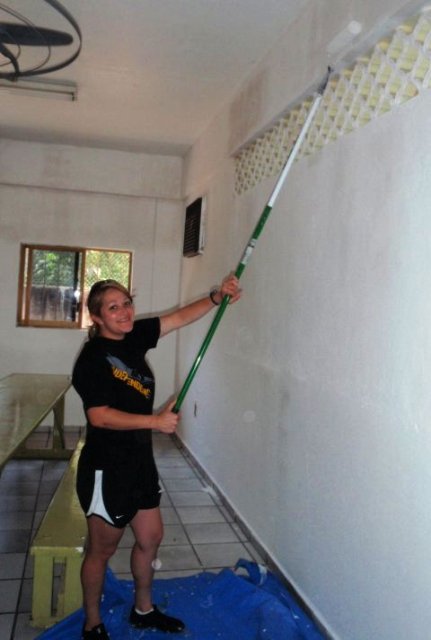
Eighteen volunteers from the ship
devoted their shore leave to painting the large comedor, or
dining room at the Casa Hogar, bringing with them all the tools to get
the job done. It was a 2-day project, made more difficult by the fact
the volunteers had no primer (and were painting white over a dark
yellow-brown), and the paint provided by another donor was not of the
best quality. However, they cheerfully kept working and got the job
done--albeit with 4 coats of white--but definitely an improvement over
the old peeling paint.
The team effort was part of the U. S. Navy's Project Handclasp, the only
program of its type in the U.S. armed forces. Handclasp is a
people-to-people program that accepts and transports educational,
humanitarian and goodwill material donated by America's private sector
on a space-available basis aboard U.S. Navy ships for distribution to
foreign nation recipients. |
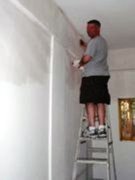
Bob does the finishing touches |
The sailors affiliated with project Handclasp also brought hygiene and medical
supplies, as well as stuffed animals, donated by Loving Hugs, Inc. to the
children's facility.
Casa Hogar Director Ramos, who is as committed as any
mother to her large brood of children, said, "These people are wonderful. We
would have a lot more problems here if we didn't have people like this who are
generous and giving of themselves, their time and money." The foster home is
totally dependent on volunteers and donations to survive. It receives no funding
from any government organization.
According to Susan Dearing, owner of
www.gomanzanillo.com, during 2 months of e-mail correspondence with
Independence Information Systems Technician 1st Class Gina Myers, Project
Handclasp was looking for an orphanage to help. Myers, who helped organize the
community service project, was informed through Ms. Dearing that Liborio
Espinosa was the most under funded and neediest children's facility in
Manzanillo.
"This is Independence's first port visit to a foreign country, so it's a
fantastic opportunity for us to get out and interact with the locals," Myers
said.
|
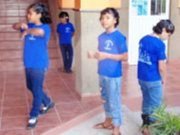
Last call for the baño |
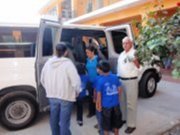
Getting in Juan Navarro's van |
On the final day the ship was in port, a tour was arranged with the help of
Susan Dearing and the "guardian angel" of Manzanillo, Roberto Soberano. Soberano
has two radio talk shows each day, where people call in about problems
or issues, and he goes out and finds answers, usually solving the problem. He also
writes a column in the newspaper, El Noticiero, about current
issues and events. |
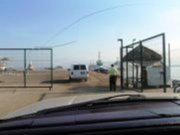
Arrival at the dock |
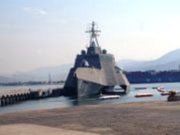
U.S.S. Independence |
|
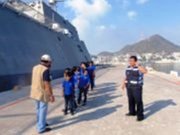
Lining up to board |
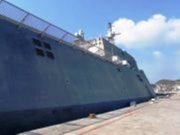
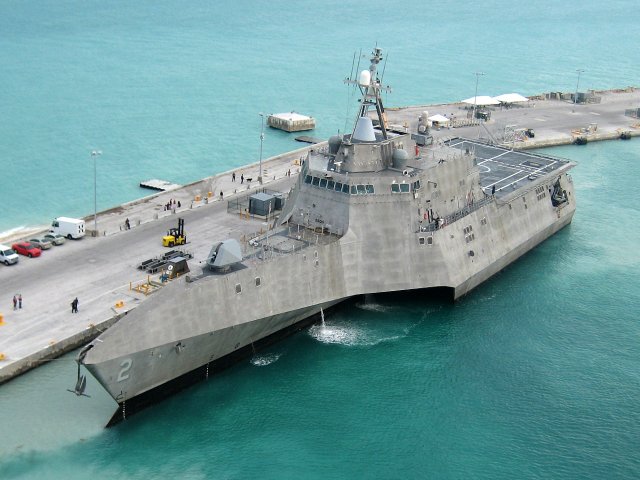
Length: 418 ft. (127.4 mt.) |
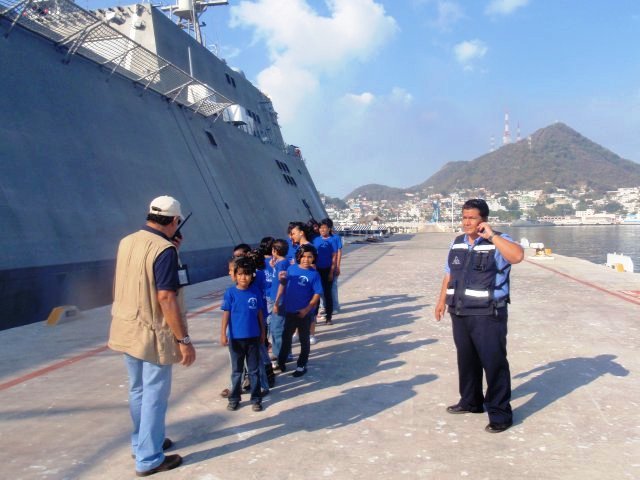
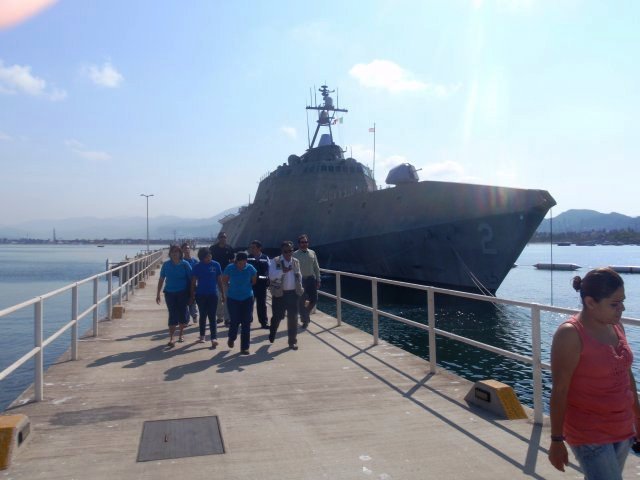
The 15 children of Liborio Espinosa had the opportunity to go where no
child of Manzanillo has gone before--aboard a U.S. warship!
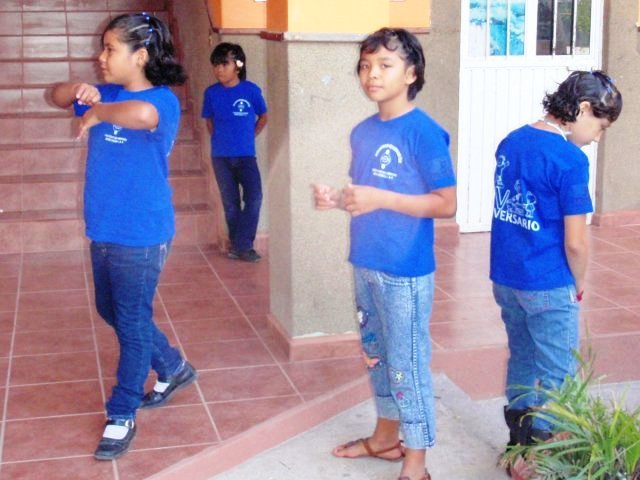
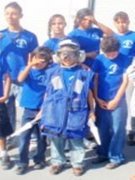
The children, wearing their
15th Anniversary Liborio Espinosa T-shirts, were welcomed by a crew
member, and then given instructions on how to walk from the dock to the
gangplank. As they lined up to enter the ship, you could see and feel their
excitement and anticipation. |
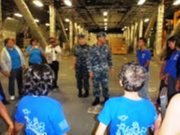
Inside the helicopter hangar |
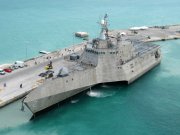
The U.S. Navy's newest |
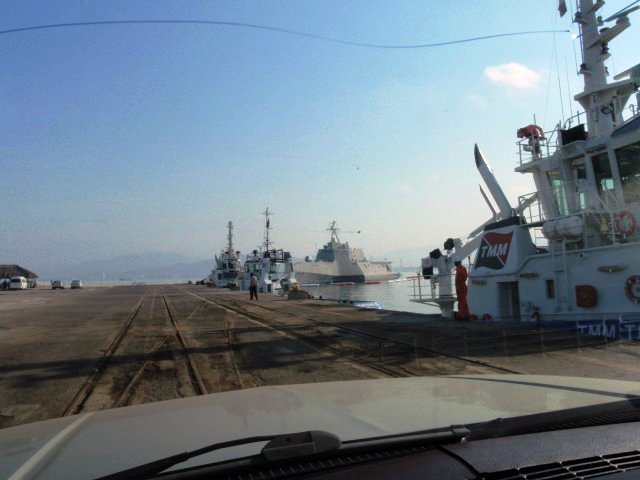
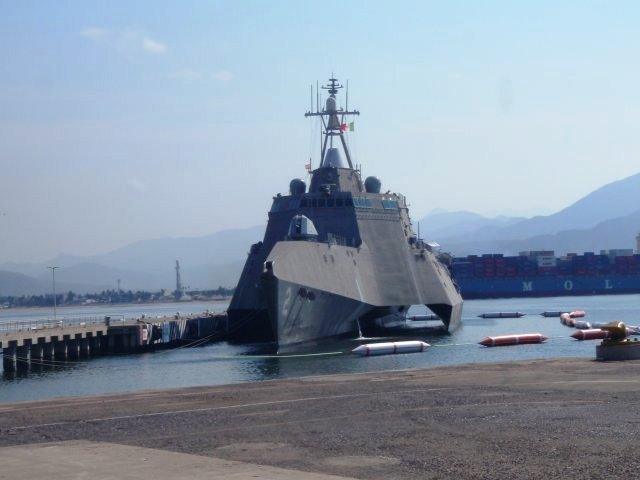
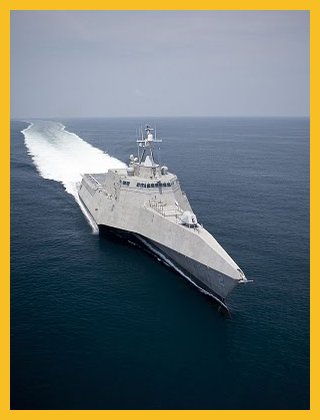
The U.S.S. Independence LCS (Littoral Combat Ship)--a scary-Star
Wars-type-looking ship--was docked at the Manzanillo's new cruise ship pier,
with the 40-person crew eagerly awaiting the little ones from the orphanage.
(Director Ramos allowed the children to "play hooky" from school for an
hour-and-a-half for this special tour of the ship.)
|
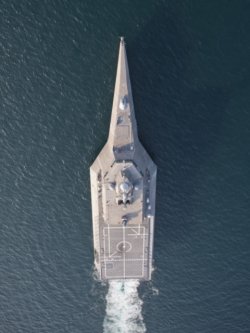 |
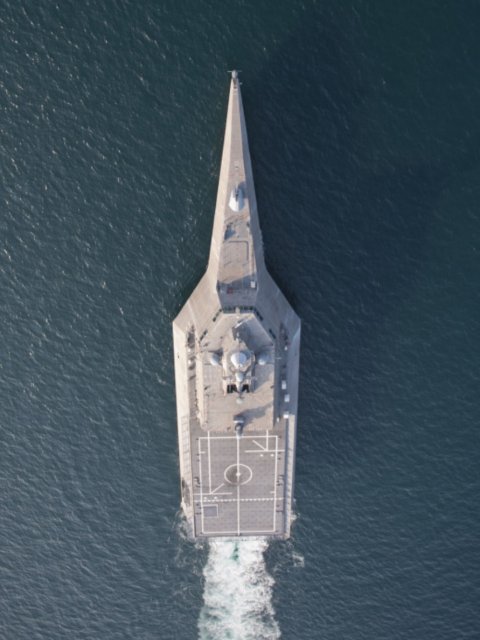
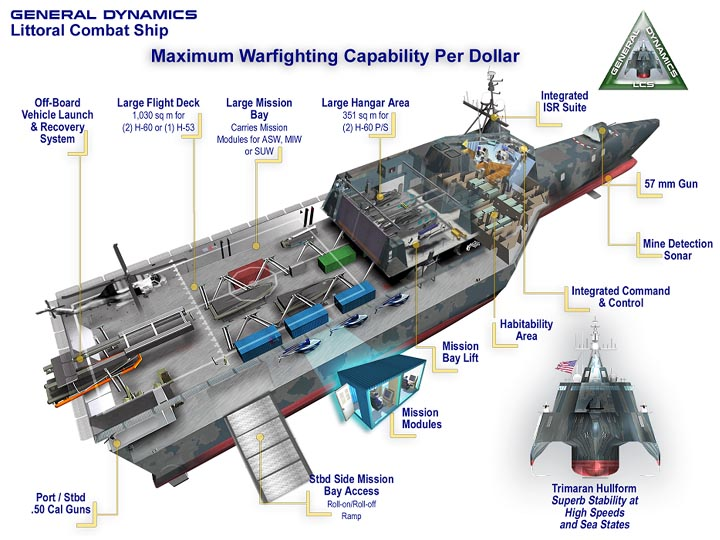
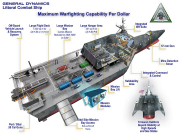
For the uninitiated, a littoral combat
ship (LCS) is a type of relatively small surface vessel intended for
operations in the littoral zone (close to shore). It is a networked,
agile, stealthy surface combatant capable of defeating anti-access and
counterinsurgency threats (such as the Somalian pirates) in shallow
waters.
An LCS ship such as the Independence, has the capabilities of a
small assault transport with a flight deck and hangar large enough to
base two SH-60 Seahawk helicopters, the capability to recover and launch
small boats from a stern ramp, and enough cargo volume and payload to
deliver a small assault force with armored fighting vehicles to a
roll-on/roll-off dock. The
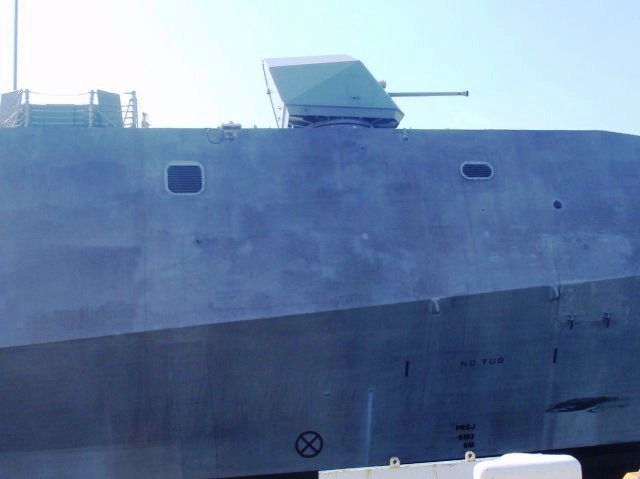
standard armament for the LCS are Mk 110 57mm guns and Rolling Airframe
Missiles. It is also able to launch autonomous air, surface and
underwater vehicles. The LCS concept emphasizes speed (50 knots; 60 mph;
100 kph), flexible mission module space, a shallow draft (14 ft, 4.5 mt.),
and "stealth-like" design for a lower radar profile.
The ship is easy to reconfigure for
different roles, including anti-submarine warfare, mine countermeasures,
anti-surface warfare, intelligence, surveillance and reconnaissance,
homeland defense, maritime intercept, special operations, and logistics.
Due to its modular design, the LCS will be able to replace slower, more
specialized ships such as minesweepers and larger assault ships. |
|
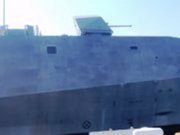
57 mm gun on bow |
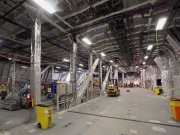
Mission bay |
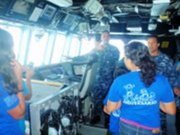
No photos of this, please |
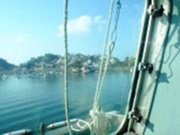
View of ZLO from the bridge |
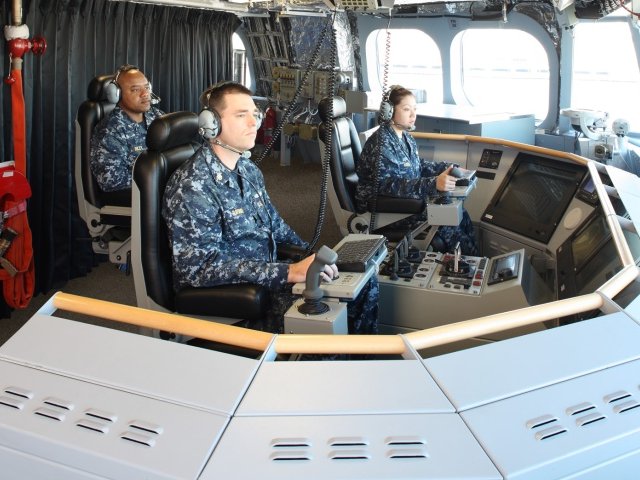
Inside the bridge |
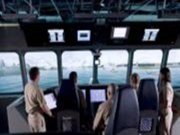
Steering with a joystick |
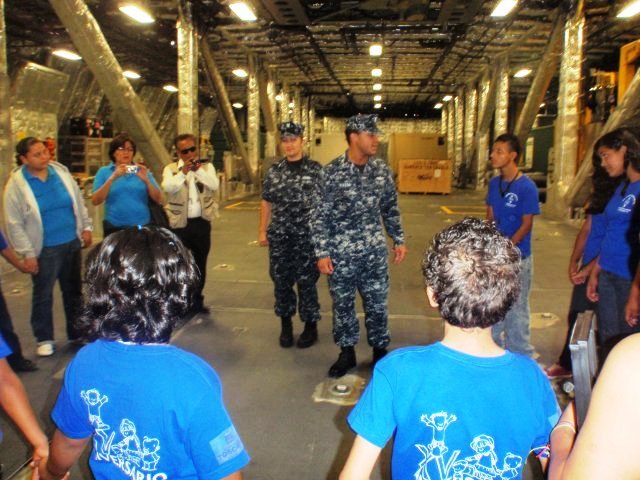
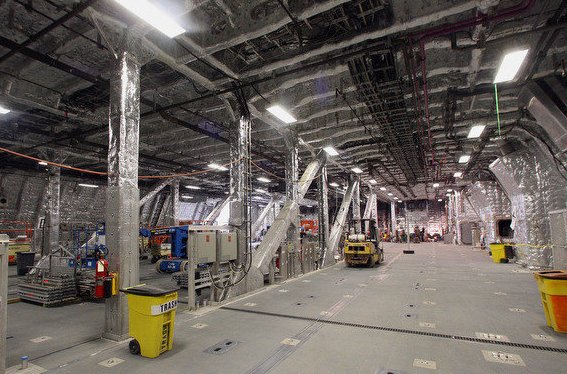
Crossing the threshold into the helicopter hangar seaman Rivera explained the
purposes and other details of the huge structure.
The interior volume and payload of the Independence is greater than some
destroyers and is sufficient to serve as a high-speed transport and maneuver
platform. The mission bay is 15,200 square feet (1,410 m2), and takes up most of
the deck below the hangar and flight deck.
In addition to cargo or container-sized mission modules, the bay can carry four
lanes of Stryker armored tanks, armored Humvees, and their associated troops. An
elevator allows air transport of packages the size of a 20-foot-long (6.1 m)
shipping container that can be moved into the mission bay while at sea. A side
access ramp allows for vehicle roll-on/roll-off loading to a dock and allows the
ship to transport the Expeditionary Fighting Vehicle.
|
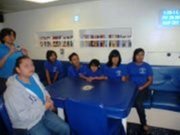
Galley |
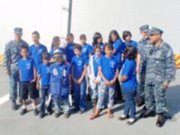
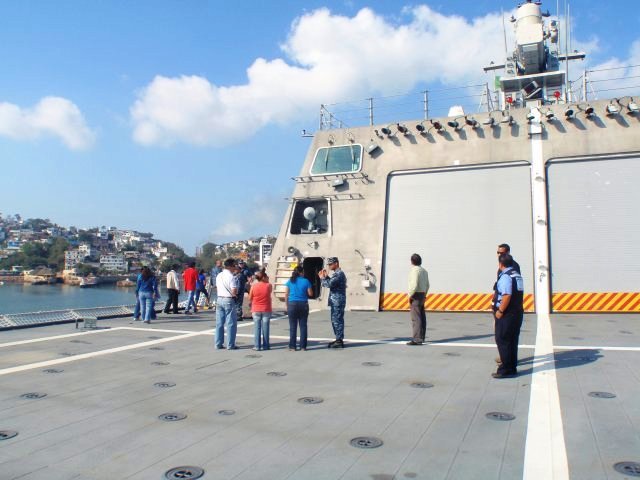
Group together on flight deck |
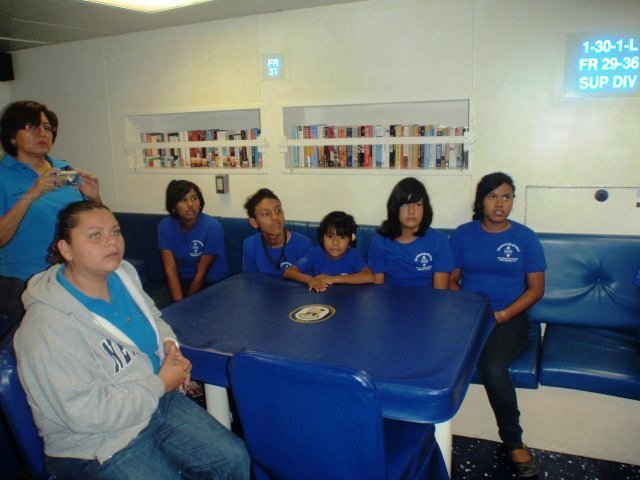
The tour group was
walked through the corridors, past the sleeping dorms, and into the
galley with comfortable seating, a book library, and internet
modules "for the crew when they are not on duty." The odors emanating from the
kitchen smelled delicious, and the sailor-chef on duty claimed "It's the best
food in the world"! Feeding a crew of 40, plus another 21 when they are on a
mission, is hard work, and takes some really huge equipment in a relatively
small, yet efficient kitchen. |
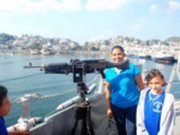
M240 machine gun on deck |
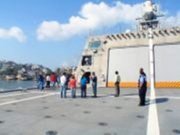
7,300 sq. ft. flight deck |
As everyone walked up and down steps, through door locks and down corridors, all
thankfully air-conditioned, the group of 26 began to see what living on a U.S.
Navy vessel was all about. The young sailors were exceedingly cheerful and
accommodating, making sure the children walked carefully, used the handrails and
stayed safe. The children, not surprisingly, were very well behaved, and
followed instructions to the letter.
|
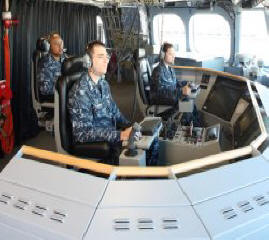 |
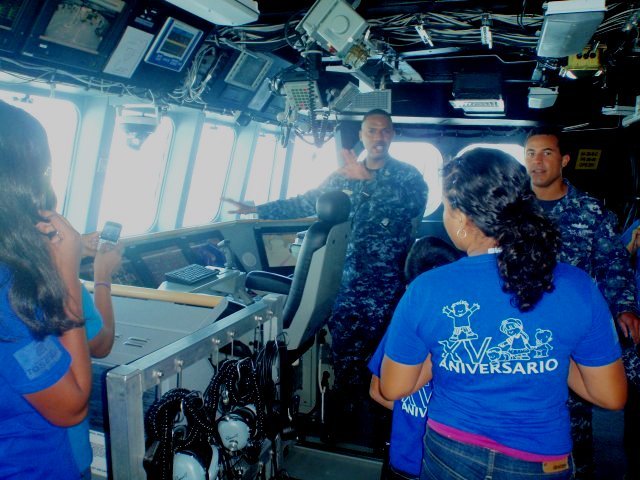
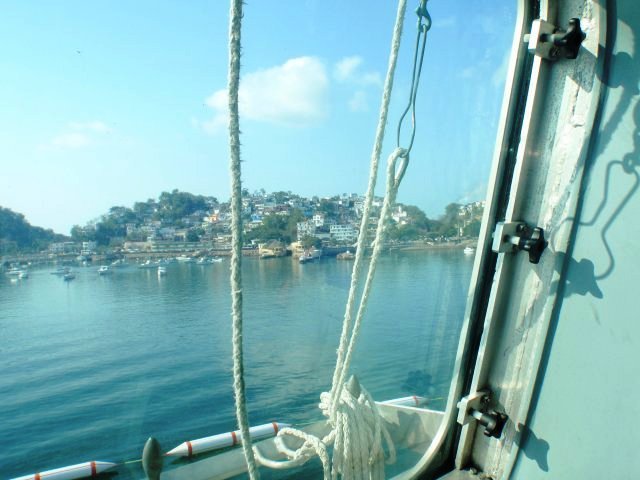
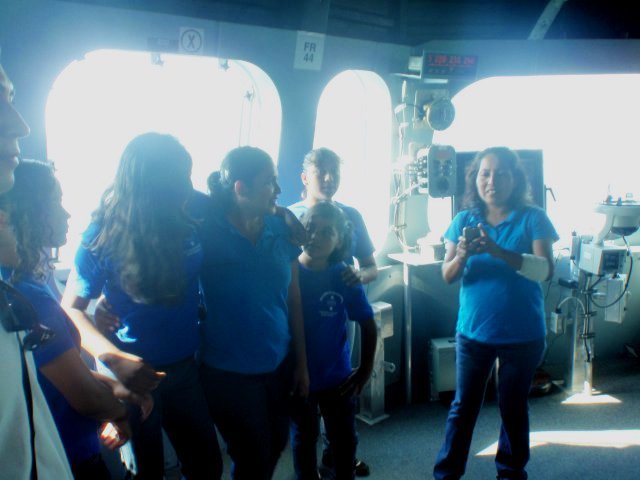
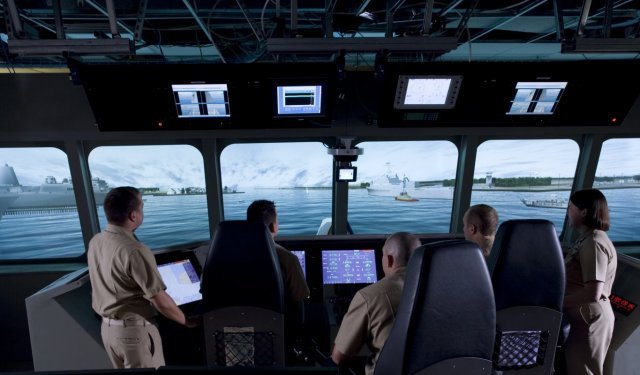
Going up approximately 4 stories to the bridge, the view of downtown Manzanillo
from the 180-degree arch of windows was spectacular.
The helm is controlled by joysticks instead of traditional steering wheels, and
has an Interior Communications Center that can be curtained off from the rest of
bridge.
The Independence uses the Integrated Combat Management System (ICMS).
ICMS is designed for use in maritime patrol, coastal surveillance, and search
and rescue.
A network of workstations, ICMS ties together a ship's key subsystems to give
commanders a single mechanism for managing their resources.
ICMS provides: real-time fusion
of multiple radar, IFF, standard US and NATO tactical datalinks, with
environmental navigation charts, radar video and TV video displays; integration
with fire-control systems; real-time, in-situ active and passive sonar
performance; full integration with internal and external communication systems;
IR and TV video distribution; integration with watch on integrated bridge
systems; integration with helicopter landing system; and data recording and
mission reproduction. Certain areas of the bridge were off-limit to photos.
|
|
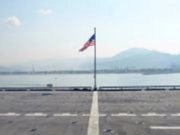
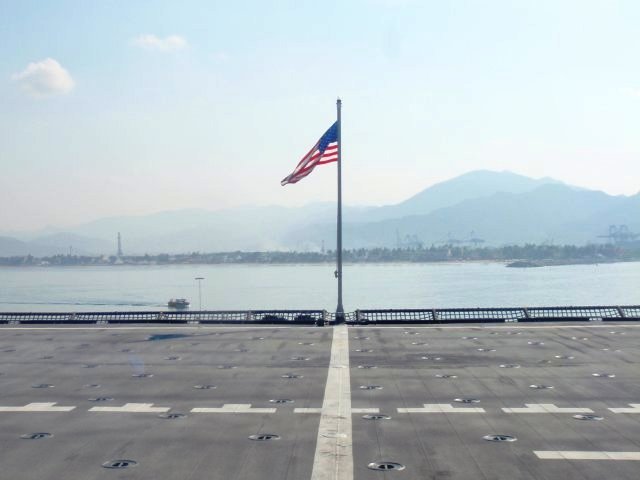
American flag waves
on flight deck |
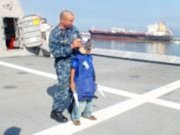
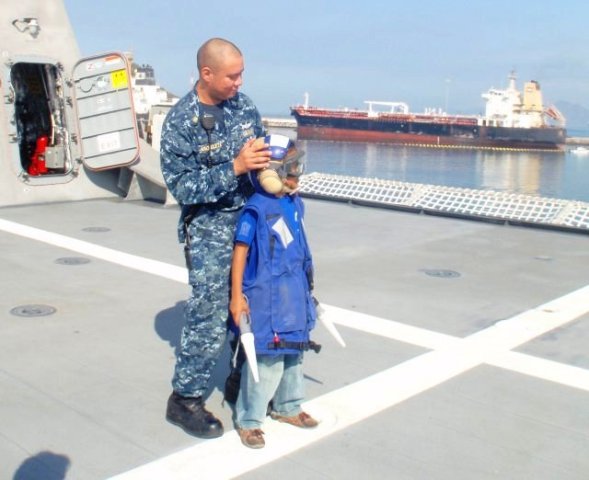
Soldier Robert Archuleta & "LSO" from the Casa Hogar |
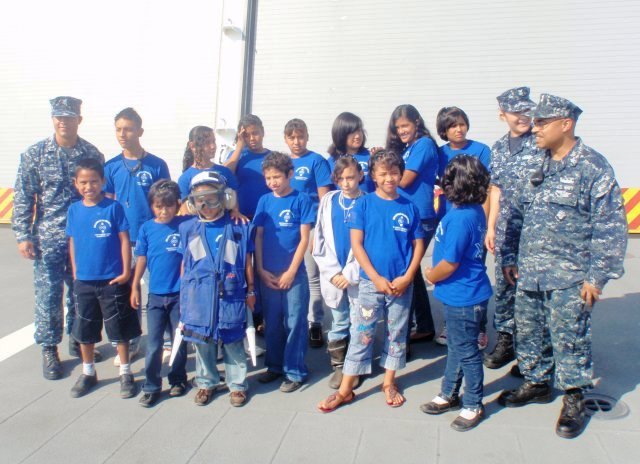
The outing ended on the flight deck, where the American flag proudly flew in
Manzanillo's gentle breezes.
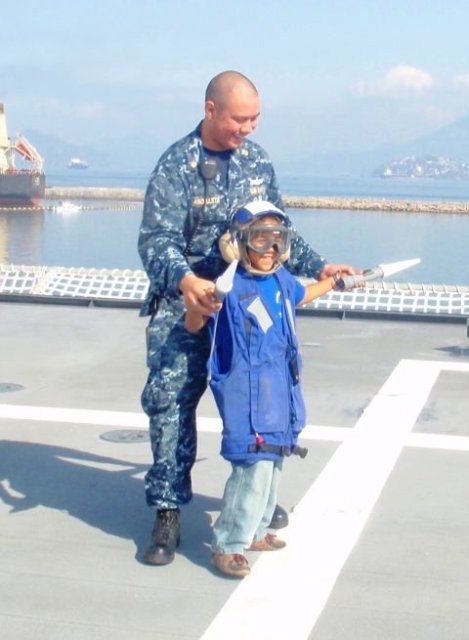
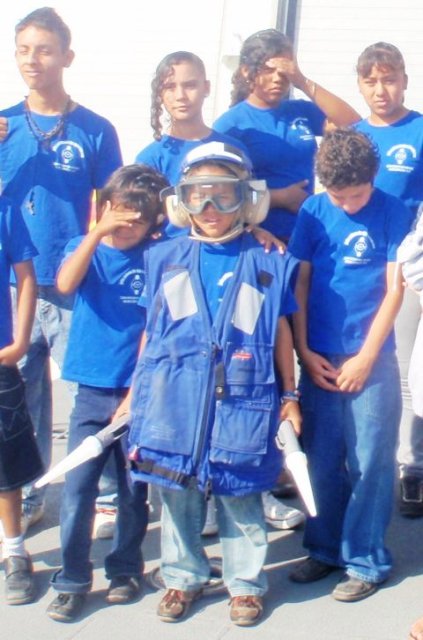
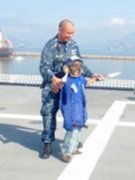
One of the children was allowed to become the
ship's LSO (landing signal officer), "guiding" a make-believe helicopter in for
a landing. All young eyes were on the Liborio Espinosa LSO, complete with
vest, helmet, ear-protectors, goggles, and light batons. |
 |
 |
|
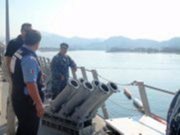
Missile canisters |
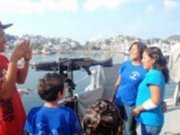
7.62 caliber; range 1,100 m |
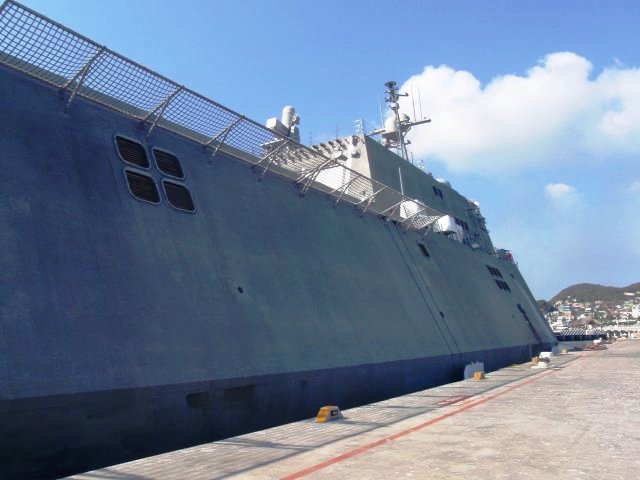
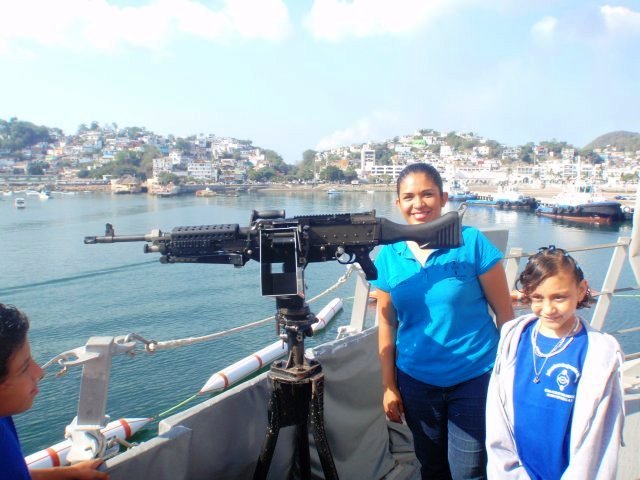
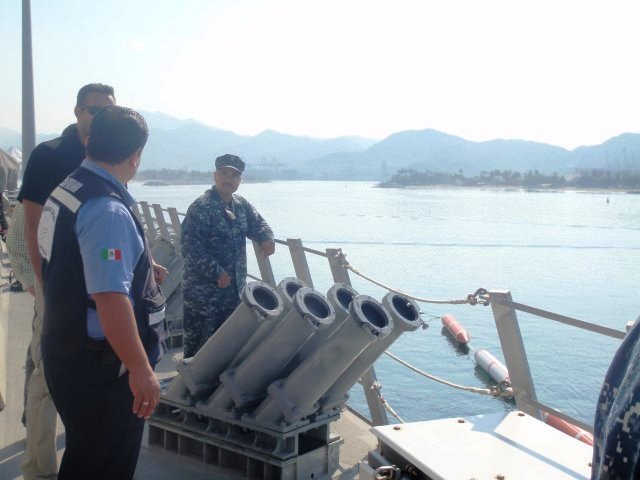
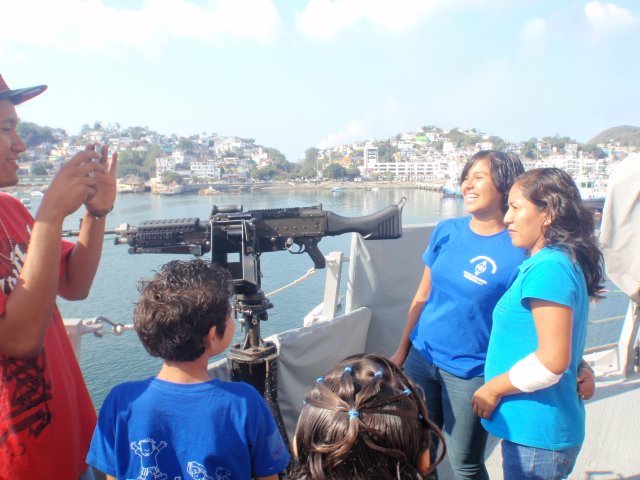
Walking around the
exterior of the ship, which is a dark, dull gray, not unlike the finish
on a B-2 "Stealth" bomber, you could see the missile canisters (used
only for defense, according to Rivera), and a mounted machine gun on the port side,
which fascinated everyone. Though a few of the soldiers were armed and on duty,
they were cordial and relaxed with the group of children around them. |
Dir. Ramos with the M-240 |
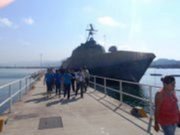
Leaving the Independence |
Finally, the 1-1/2 tour came to an end, to the extreme satisfaction to all who
were lucky enough to come on board and see one of the newest combat ships in the
U.S. Navy.
 |
A SPECIAL THANKS to the crew of the Independence for their hospitality, from the kids and staff of the Casa Hogar, Susan Dearing, and
Roberto Soberano,
and hats off to BMC Robert Archuleta and IST Gina Davis of Project Handclasp for helping
to give the children a dream come true, and make their home at the Casa Hogar
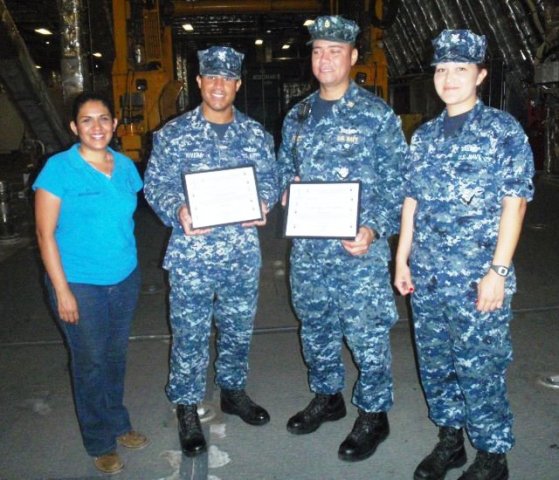
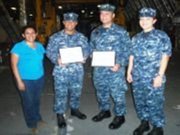
a little better and brighter. Certificates of appreciation were presented to the
captain and crew of the U.S.S. Independence (photo, right).
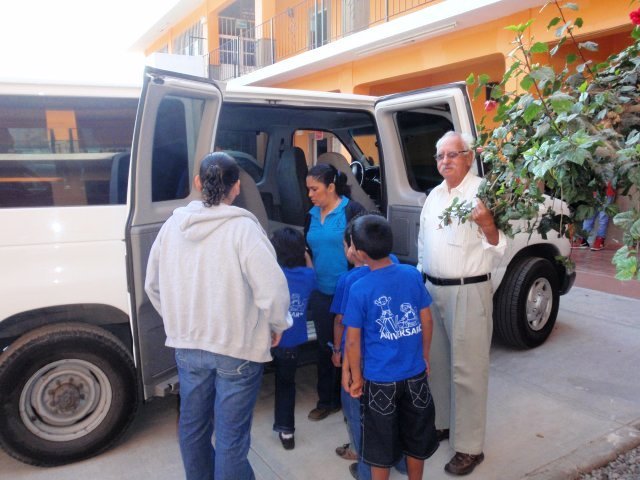
Thanks also to Juan Navarro, who drove the
children in his 15-passenger van to the dock and back home.
If you'd like to help the
children of the orphanage, contact
Susan.
|
 |