 June
1 is Navy Day, or Dia De La Marina in Manzanillo.
June
1 is Navy Day, or Dia De La Marina in Manzanillo.
Manzanillo celebrates Navy Day
Special thanks to the Fuerza Naval del Pacifico for some of the photos and information provided in this article.
June
1 is Navy Day, or Dia De La Marina in Manzanillo.
Mexico's history has shown the importance of being able to patrol and defend the country's coastlines, in order to prevent invasions. Many such conflicts have occurred in Mexico's past.
Along with defense, there is a need to develop and take advantage of the oceans in a rational and organized way. To Mexico, its seas are also a great source of bounty and employment.
 For these reasons, the history of
the Mexican National Navy runs parallel to the birth of Mexico as a nation in
the year 1821.
For these reasons, the history of
the Mexican National Navy runs parallel to the birth of Mexico as a nation in
the year 1821.
The Mexican National Navy has been a prime protagonist in every phase of this country's development as a free, independent and sovereign country.
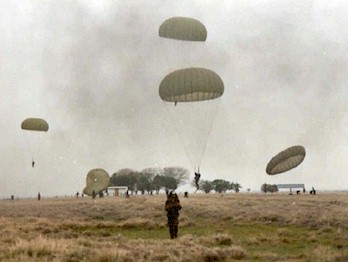 Several
years ago former President Vicente Fox arrived at Manzanillo's International Playa de Oro airport,
and viewed first-hand the Navy's defense. A mock
terrorist attack and hijacking of a plane with hostages was thwarted by the
Navy's special forces team. Some parachuted down, while others rappeled
from a helicopter--and just like the RCMP, they got their man.
Several
years ago former President Vicente Fox arrived at Manzanillo's International Playa de Oro airport,
and viewed first-hand the Navy's defense. A mock
terrorist attack and hijacking of a plane with hostages was thwarted by the
Navy's special forces team. Some parachuted down, while others rappeled
from a helicopter--and just like the RCMP, they got their man.
Fox was transported by helicopter from the airport to the Veracruz (PC-226), a coastal patrol craft.
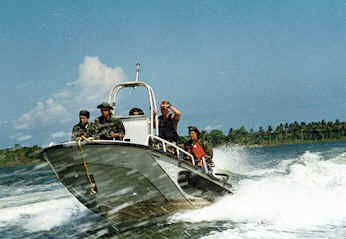 After
boarding the Veracruz, President Fox observed the Navy deploying their special forces in Manzanillo Bay.
After
boarding the Veracruz, President Fox observed the Navy deploying their special forces in Manzanillo Bay.
Again, the Navy's elite "intercepted a boat laden with drugs," and busted the bad guys.
Upon completion of the Navy's special forces exercises, the president reviewed ("Revista") the Mexican National Navy. Following, the Revista, President Fox and staff proceeded to San Pedrito, where he disembarked the Veracruz and participated in various civic ceremonies with the governor, and the mayor of Manzanillo.
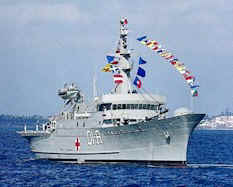 Anyone
wishing to observe the events of the Dia De La Marina were invited to board the
ship "Manzanillo" (A-402), which was moored at the
fiscal peer.
Anyone
wishing to observe the events of the Dia De La Marina were invited to board the
ship "Manzanillo" (A-402), which was moored at the
fiscal peer.
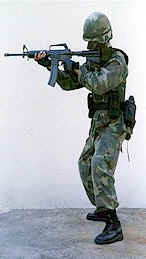 Manzanillo is the home port of the Mexican Navy on the Pacific
Coast. Visitors to Manzanillo will notice the military presence here, which
includes not only the navy, but the army as well.
Manzanillo is the home port of the Mexican Navy on the Pacific
Coast. Visitors to Manzanillo will notice the military presence here, which
includes not only the navy, but the army as well.
The military has many important functions other than defense. In the event of a natural disaster, the forces are deployed to give emergency first aid, participate in rescue operations, build temporary shelters and distribute food, guard against looting, and even dig or search the sea for survivors.
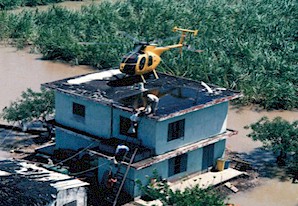 They routinely assist in floods, hurricanes and earthquakes.
They perform sea rescues.
They routinely assist in floods, hurricanes and earthquakes.
They perform sea rescues.
They protect sea turtles, whales and dolphins, and they clean up the beaches. During Fox's term, he proclaimed that whales would be protected in Mexico's waters.
During major holidays, when there are lots of vacationers in Manzanillo, they safeguard the beaches, and set up checkpoints to look for drugs and guns.
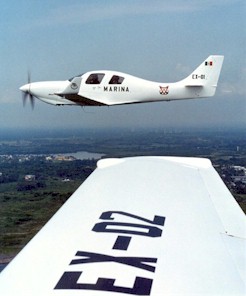 In addition to the Navy's fleet, consisting of surface
combatants, patrol craft and auxiliary vessels, it also maintains a contingency
of helicopters and fixed-wing aircraft.
In addition to the Navy's fleet, consisting of surface
combatants, patrol craft and auxiliary vessels, it also maintains a contingency
of helicopters and fixed-wing aircraft.
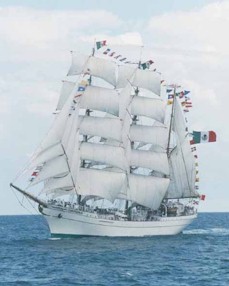 The Cuauhtemoc is a sail training ship (297 x 39 x 17 ft.)
Spanish built for Mexico in 1982.
The Cuauhtemoc is a sail training ship (297 x 39 x 17 ft.)
Spanish built for Mexico in 1982.
She carries a crew of 185, and 90 cadets.
Her displacement is 1,760 tons (full load), and is propelled by sail with an auxiliary diesel, and can attain a speed of 11 knots.
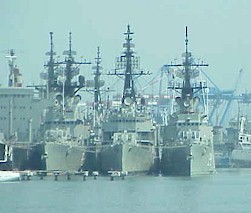
The Knox class ASW frigates (opening photo) displace 4,250 tons, have steam turbines, and can attain 27 knots, with a crew of approximately 250. There is an aft helicopter deck and hangar, radar, sonar, and it is armed with mounted cannons for MK-32 torpedoes, and antisubmarine rocket launchers. It can reach speeds up to 27 knots.
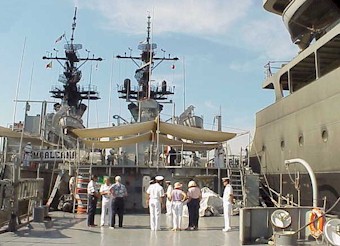 The (Bronstein) class patrol Frigates, such as the recently
decommissioned Nicholas Bravo (F-201), is being refurbished and is used
primarily for public relations.
The (Bronstein) class patrol Frigates, such as the recently
decommissioned Nicholas Bravo (F-201), is being refurbished and is used
primarily for public relations.
Displacing 2,650 tons, steam driven, it can attain speeds of up to 24 knots.
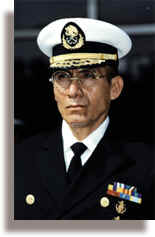 Recently, the Commander of the Pacific Fleet, Admiral
Casimiro
A. Martinez Pretelin invited a group of Manzanillo ex-pats to breakfast at the
officer's club, followed by a tour of the Nicholas Bravo.
Recently, the Commander of the Pacific Fleet, Admiral
Casimiro
A. Martinez Pretelin invited a group of Manzanillo ex-pats to breakfast at the
officer's club, followed by a tour of the Nicholas Bravo.
Present were retired USN Captain and Mrs. Roy Edgar McCoy, former USMC Sgt. Carlos Cuellar, Underworld Scuba owner Susan Dearing, and Bart Varelmann and Inga Schilling, former owners of the Hotel La Posada.
For Dia De La Marina, Carlos and Susan were invited aboard the ship, M.P Zapoteco (AMP-02), that will navigate alongside the President's ship, the Veracruz.
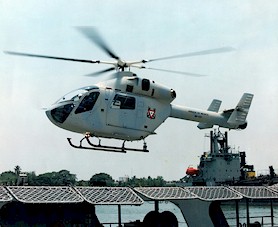 The Navy's fleet performed air,
land and sea maneuvers viewed by everyone in Manzanillo. The Las
Brisas area was an excellent location from which to view the exhibition of
Mexico's military force. This year, 2011, there will not be a huge ceremony,
simply a floral wreath thrown overboard from a frigate, to honor those who make
their livelihood from the sea. According to the Captain of the Port, Enrique Casarubias, this decision was made because of the economic recession.
The Navy's fleet performed air,
land and sea maneuvers viewed by everyone in Manzanillo. The Las
Brisas area was an excellent location from which to view the exhibition of
Mexico's military force. This year, 2011, there will not be a huge ceremony,
simply a floral wreath thrown overboard from a frigate, to honor those who make
their livelihood from the sea. According to the Captain of the Port, Enrique Casarubias, this decision was made because of the economic recession.
The above page, part of the excellent web site for the Mexican Navy, gives you the names, numbers, and types of all ships in the Mexican Navy. For readers who just want some brief information, read below. To best enjoy the Navy's fantastic site, you should have Flash Multimedia and sound.
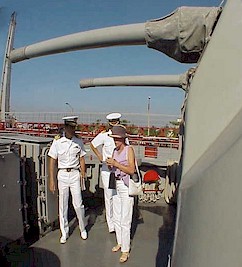 Class patrol frigates have the letter designation
"E" followed by a number. The decommissioned Nicholas Bravo, F-201,
(left), was
formerly numbered E-40. Most are ex-USN, WWII-era ships. They are of 4
classes: Bronstein, Gearing FRAM I, Fletcher, or Crosley/Lawrence.
Class patrol frigates have the letter designation
"E" followed by a number. The decommissioned Nicholas Bravo, F-201,
(left), was
formerly numbered E-40. Most are ex-USN, WWII-era ships. They are of 4
classes: Bronstein, Gearing FRAM I, Fletcher, or Crosley/Lawrence.
Class patrol corvettes are either Mexican-built, Spanish-built for Mexico, British-built, or ex-US Coast Guard. They have a letter designation of "C." They have 4 classes: Aquila, Auk, Halcyon and Admirable.
 A
new type of speed boat, the Interceptor, is used for drug-related exercises, and
emergency rescues. These boats have a "PI" designation.
A
new type of speed boat, the Interceptor, is used for drug-related exercises, and
emergency rescues. These boats have a "PI" designation.
Small patrol boats carry a "P" letter designation, with 2 classes: Azteca and Cape. They are either British -built, Mexican-built, or ex-US Coast Guard.
The auxiliaries include fleet tugs (Cherokee, Quetzalcoatl V-4-Type class), which are ex-US Maritime Administration WWII era tugs. Las Choapas (YO-65 class) coastal oiler is ex-USN. Logistics ships, such as the Rio Balsa, Rio Grijalva and the Rio Lerma are ex-US Navy, Japanese-built, or Swedish-built. The Rio Balsas is the flag ship of the Mexican Navy. The Rio Lerma was a former commercial freighter. The Rio Grijalva is used as a transport. They all carry the letter designation "A."
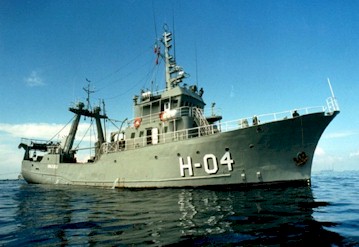 Survey ships are of the classes: Robert C. Conrad, S.P. Lee,
and Admirable. The Altair (H-04), for example, carries 26 crew members and 18
scientists. They carry the letter designation "H."
Survey ships are of the classes: Robert C. Conrad, S.P. Lee,
and Admirable. The Altair (H-04), for example, carries 26 crew members and 18
scientists. They carry the letter designation "H."
The Mexican Navy, with the support of former President Fox, has come a long way toward modernization.
Its motto is: "Over land, in the air, and on the sea."
For more photos click here.
Attention! Will passengers please watch your step as you disembark!